Wrist Pain From Swimming Is Almost Always the Catch (Here Is the Fix)
Quick Answer: Swimming wrist pain almost always comes from a dropped wrist at the catch - letting the hand bend backward as it enters and begins to pull, which puts the joint in extension under load hundreds of times per session. Keep the wrist in neutral alignment with the forearm through the catch, and cut paddle volume until it stops.
Swimming is supposed to be the joint-friendly option. That is half the reason people choose it.
So wrist pain from swimming feels like a betrayal, and most swimmers assume they must be doing something exotically wrong.
They are usually doing one specific, extremely common thing wrong - and it is fixable inside two sessions.
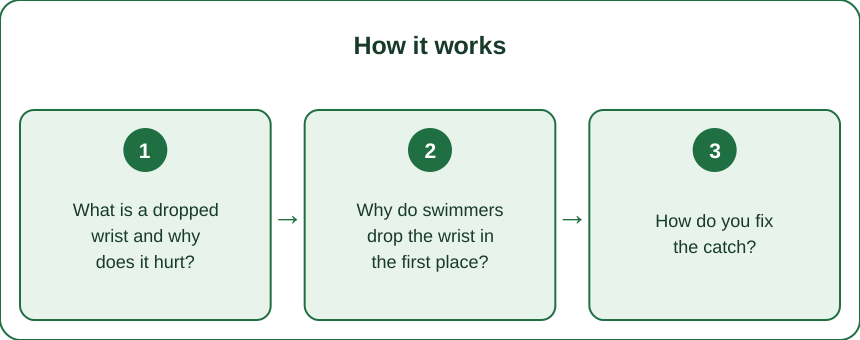
What is a dropped wrist and why does it hurt?
At the front of the freestyle stroke, your hand enters the water and then begins the catch - the phase where you set your hand and forearm against the water to pull.
A correct catch keeps the wrist straight in line with the forearm, so the hand and forearm act as a single paddle. A dropped wrist bends backward at the joint, so the hand trails behind the forearm.
When that happens, every pull loads the wrist joint in extension against water resistance. A moderate session is 1,500-2,500 strokes, which means thousands of loaded repetitions in a compromised position.
The pain typically shows up on the back of the wrist and appears during or after longer sets rather than in the first few laps. It is a volume and position problem, which is why it seems to arrive suddenly when your yardage increases.
Why do swimmers drop the wrist in the first place?
Three reasons, in rough order of frequency:
Reaching too far forward on entry. Overreaching pulls the shoulder into full extension, and the wrist collapses to make up the distance. This is by far the most common cause and it usually accompanies a stroke that feels long and looks flat.
Weak forearm and grip endurance. Holding a neutral wrist against water pressure requires forearm work. As those muscles fatigue late in a session, the wrist gives first. If your pain is only in the last third of a workout, this is likely.
Paddles. Paddles multiply the force on the hand substantially, and any wrist position error is amplified by the same factor. Adding paddles to a stroke with a dropped wrist is the fastest route to a wrist problem in the whole sport.
How do you fix the catch?
Three drills, in order:
1. Sculling at the front of the stroke. Float face down with arms extended, and make small figure-eight movements with the hands, feeling pressure on the palms. This teaches you to feel water pressure with a neutral wrist. 4 x 25 yards at the start of each session.
2. Fist drill. Swim freestyle with closed fists for 50 yards, then open your hands for 50. The contrast makes you aware of your forearm as part of the paddle, which naturally straightens the wrist. 6 x 50 alternating.
3. Catch-up drill with a focus on entry distance. Enter the hand in front of the shoulder, not past the head, with the elbow slightly bent. Shortening the entry removes the reason the wrist was collapsing.
Do these at the start of a session, not the end. Technique work on fatigued arms reinforces the fatigued pattern.
This is general information, not medical advice. Wrist pain with numbness, tingling, or weakness in the hand needs a professional assessment before you keep training.
5 Mistakes Everyone Makes With Swim Paddles
1. Sizing up too early. Larger paddles are not a training progression, they are a force multiplier. Start with paddles barely bigger than your hand and stay there for months.
2. Using paddles on long aerobic sets. Paddles belong in short, technique-focused sets. High-volume paddle swimming is where shoulder and wrist injuries come from.
3. Keeping the wrist strap. Many paddles come with a wrist strap plus a finger strap. Removing the wrist strap forces correct hand position - if your wrist drops, the paddle falls off. This is the single best self-correcting tool in swimming.
4. Adding paddles when tired. The end of a session is when your wrist position is worst, which is exactly when paddles do the most damage.
5. Ignoring a paddle that shifts. A paddle sliding on your hand means your hand is not entering flat. That is information, not an equipment defect.
What strengthens the wrist for swimming?
Forearm endurance rather than raw strength, since the demand is thousands of low-force repetitions:
- Wrist extension holds. Forearm supported on a table, hand off the edge, hold a light weight in a neutral position for 30 seconds. 3 sets each side. This trains exactly the position you need in the water.
- Pronation and supination with a light dumbbell held at one end, 2 sets of 15 each direction.
- Grip endurance work - dead hangs or farmer’s carries for 30-45 seconds, twice a week.
Two sessions a week, done on dry land, and it takes under ten minutes.
One more thing that helps and costs nothing: check your push-off. Pushing off the wall with a hyperextended wrist, several times per session, is a load nobody counts and it adds up over a long set.
FAQ: Swimming Wrist Questions, Answered
Should I stop swimming completely if my wrist hurts?
Usually not. Drop paddles entirely, reduce volume by about a third, and swim with a focus on the catch drills. Complete rest is for pain that persists at rest or wakes you at night.
Does a wrist brace help in the water?
Neoprene supports exist for swimming and can reduce symptoms short term, but they mask the position error rather than fixing it. Use one while you correct technique, not instead of correcting it.
Which stroke is hardest on the wrists?
Butterfly loads the wrists most because of the entry force, and breaststroke’s outsweep puts the wrist in an unusual position under load. Freestyle is gentlest when the catch is correct - and among the worst when it is not.
TL;DR:
- Swimming wrist pain is almost always a dropped wrist at the catch, loaded across thousands of strokes.
- The root cause is usually overreaching on entry, forearm fatigue, or paddles added too soon.
- Fix it with front sculling, fist drill, and shortening the entry to in front of the shoulder.
- Remove the wrist strap from your paddles - it makes correct position self-enforcing.
- Wrist extension holds and grip endurance work, twice a week, ten minutes total.
Swimming genuinely is the joint-friendly option. When it is not, it is telling you something specific about your catch - and that is a better problem to have than most, because the fix makes you faster too.
Keep Reading
This article is for general informational purposes only and is not medical advice. Always consult a qualified health professional for guidance specific to you.