Why Your Wrists Hurt Most in the Morning - the Sleeping Position Nobody Checks
Quick Answer: Morning wrist pain and numbness usually come from sleeping with the wrist bent - most people curl into flexion, and a bent wrist raises pressure inside the carpal tunnel several times over a neutral one. Held for six or seven hours, that produces the classic pattern of waking with numb, aching hands that ease within twenty minutes of moving. The fix is mechanical rather than medical: a neutral wrist splint worn at night, a pillow that stops the wrist folding, and avoiding sleeping on your hands. Most people notice a difference within one to two weeks.

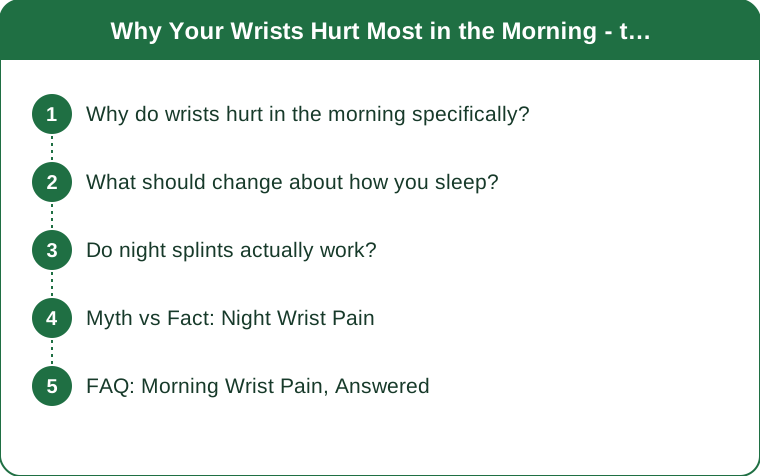
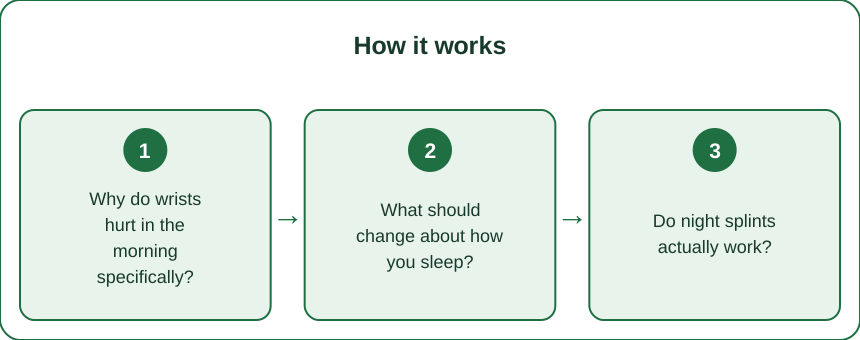
Why do wrists hurt in the morning specifically?
Sleep is the longest sustained position of your day. Nothing you do at a desk lasts six or seven unbroken hours without a single adjustment, which is exactly what makes a poor sleeping position so effective at causing symptoms.
A bent wrist compresses the carpal tunnel. Pressure inside the tunnel rises substantially in both flexion and extension compared with neutral, and the median nerve running through it does not tolerate sustained pressure well.
Most people sleep curled. The fetal position naturally folds the wrists inwards, and side sleepers frequently tuck a hand under a pillow or under their own head, adding body weight on top of the bend.
Fluid redistributes when you lie down. Circulating fluid shifts from the legs towards the upper body overnight, which slightly increases pressure in confined spaces like the carpal tunnel.
Inflammation is not being cleared by movement. Through the day, normal hand use pumps fluid through the tissues. Overnight nothing moves, so any existing irritation settles rather than dispersing.
Which produces the signature pattern. Waking with numbness or aching that eases within 10 to 30 minutes of moving and shaking the hands is characteristic, and it is the single most useful clue that position is the cause.
And daytime activity sets the stage. A heavy typing week or a session of front squats leaves tissue already irritated, and then a bent wrist overnight converts irritation into symptoms.
What should change about how you sleep?
Keep the wrist neutral - straight, in line with the forearm. This is the entire principle. Neutral is the lowest pressure position for the carpal tunnel, and everything below is just a way of achieving it.
Stop sleeping with hands under the pillow or under your head. This combines full flexion with sustained body weight, and it is the most common single cause worth eliminating first.
Try a small pillow or folded towel under the forearm if you sleep on your side. Supporting the forearm stops the hand dropping into a bend at the wrist.
Avoid sleeping on your stomach with arms overhead. That position loads both the wrist and the shoulder, and it frequently produces symptoms people attribute entirely to the hand.
Watch the elbow too. A fully bent elbow compresses the ulnar nerve and causes numbness in the ring and little fingers - a different nerve with a similar overnight story.
Keep hands outside heavy bedding if you tend to grip or curl. Weight of covers encourages the fist position that maintains flexion all night.
And give it two weeks before judging. Sleep position is a deeply ingrained habit, and it takes consistent nudging rather than one determined night.

Do night splints actually work?
Yes - night splinting is one of the better-supported conservative measures for wrist and carpal tunnel symptoms, precisely because it addresses the sustained position that causes them.
The point is to hold neutral, not to immobilise. A good splint prevents the wrist folding while you are unconscious and unable to correct yourself, which is the whole mechanism.
Fit matters more than brand. It should be snug enough to prevent bending and loose enough not to restrict circulation - waking with new numbness in the fingertips means it is too tight.
Check the metal stay. Many splints come with a spar that is pre-bent into slight extension. Neutral is the target, and the stay can usually be flattened by hand.
Expect one to two weeks before a clear verdict, and expect the first two or three nights to be genuinely annoying while you get used to it.
Wear it at night rather than during the day. Daytime splinting weakens the forearm over time and interferes with normal movement. Night use avoids both problems.
And treat a splint as diagnostic as well as therapeutic. If a neutral splint largely resolves your mornings, position was the driver - which is genuinely useful information.
Myth vs Fact: Night Wrist Pain
Myth: Morning wrist pain means you have arthritis. Fact: Position-related nerve compression is far more common, and it has a distinct signature - numbness that clears within 10 to 30 minutes of moving. Persistent morning stiffness lasting over an hour is a different pattern worth assessing.
Myth: Shaking your hands out in the night is harmless. Fact: It works, but needing to shake your hands awake is itself a symptom worth acting on rather than a coping strategy.
Myth: A tighter splint works better. Fact: Tighter restricts circulation and creates new symptoms. The job is to prevent bending, and that needs snug rather than tight.
Myth: You should wear the splint all day for faster results. Fact: Daytime immobilisation weakens the forearm and is not how the benefit is produced. Night use is where the evidence sits.
Myth: If it only happens at night, it is not serious. Fact: Night symptoms are frequently the earliest sign of carpal tunnel syndrome. Addressing it at this stage is precisely the point.
Myth: A pillow between the knees has nothing to do with wrists. Fact: It stabilises your side-sleeping position overall, which reduces the mid-night rolling that puts hands under heads in the first place.
FAQ: Morning Wrist Pain, Answered
Why are my hands numb when I wake up?
Usually because the wrist has been bent for hours, which raises pressure in the carpal tunnel and compresses the median nerve. Numbness that clears within 10 to 30 minutes of moving is the classic sign.
What is the best sleeping position for wrist pain?
Any position where the wrist stays neutral - straight and in line with the forearm. On your side, support the forearm so the hand does not drop into a bend, and keep hands out from under the pillow.
Do wrist splints help at night?
Yes. Night splinting is among the better-supported conservative measures, because it holds neutral during the long stretch you cannot control consciously.
How tight should a night splint be?
Snug enough to prevent bending, loose enough that circulation is unaffected. New fingertip numbness or colour change means loosen it.
How long until it improves?
Most people notice a difference within one to two weeks of consistent neutral positioning. The first few nights with a splint are usually the worst part.
Why does it affect only some fingers?
Thumb, index, middle, and half the ring finger point to the median nerve at the wrist. Ring and little finger point to the ulnar nerve, often from a fully bent elbow rather than the wrist.
When should I see someone about it?
If symptoms persist beyond a few weeks of position changes, wake you repeatedly every night, involve weakness or dropping things, or if you notice muscle wasting at the base of the thumb. This is general information, not medical advice.
TL;DR:
- Morning wrist pain is usually a position problem, not a mystery - a bent wrist held for six or seven hours compresses the median nerve.
- The signature is numbness that clears within 10 to 30 minutes of moving and shaking the hands.
- Neutral is the target: wrist straight, in line with the forearm.
- Stop sleeping with hands under the pillow or your head - flexion plus body weight is the worst combination.
- Night splints work, and they double as a diagnostic. Snug, not tight, and flatten the metal stay to true neutral.
- Check the elbow too - ring and little finger numbness usually means the ulnar nerve and a fully bent elbow.
- Give it one to two weeks of consistent positioning before judging.
See someone if symptoms persist for weeks, involve weakness or dropping things, or if there is wasting at the base of the thumb. This is general information, not medical advice.
Keep Reading
This article is for general informational purposes only and is not medical advice. Always consult a qualified health professional for guidance specific to you.