The Wrist Brace Mistake That Makes Phone-Scrolling Wrist Pain Worse, Not Better
Quick Answer: A general wrist brace designed for broad wrist stabilization can actually worsen thumb-and-wrist pain caused by repetitive scrolling, since it often doesn’t immobilize the thumb’s base joint — the specific area most affected by scrolling motion — and can instead shift strain to nearby tendons that then compensate for a wrist that’s braced but a thumb that’s still moving freely.
Many people reach for whatever wrist brace is available for any hand or wrist discomfort, without realizing scrolling-related pain usually needs a thumb-specific brace design, not a general wrist one.

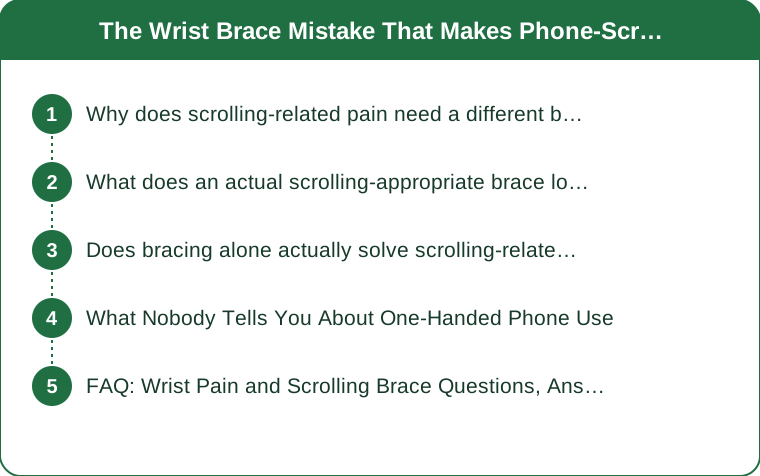
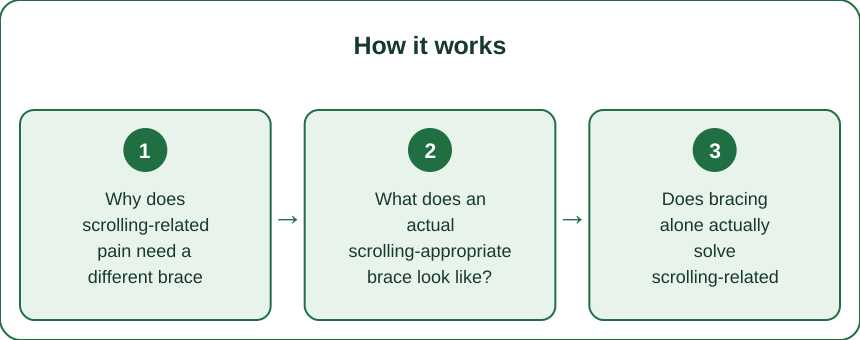
Why does scrolling-related pain need a different brace than general wrist pain?
Because repetitive scrolling primarily strains the tendons at the base of the thumb (a condition sometimes related to De Quervain’s tenosynovitis), not the wrist joint itself broadly. A general wrist brace stabilizes the wrist but typically leaves the thumb free to keep moving, meaning the actual overworked tendons keep working while the wrist — which wasn’t the main problem — gets restricted instead.
What does an actual scrolling-appropriate brace look like?
A thumb spica-style brace, which immobilizes the thumb’s base joint and lower wrist together, specifically addresses the tendons involved in repetitive scrolling and swiping motion — this is a meaningfully different design from a general wrist wrap or brace, and checking for thumb immobilization specifically, not just wrist coverage, is the key differentiator when choosing one.

Does bracing alone actually solve scrolling-related wrist pain?
Not entirely — bracing helps by limiting further aggravating movement, but reducing actual scrolling time and taking regular breaks addresses the root repetitive strain cause, which a brace alone doesn’t fix. Bracing without behavior change often means the pain returns once the brace comes off, since the underlying repetitive motion hasn’t changed.
What Nobody Tells You About One-Handed Phone Use
Switching which hand does the scrolling motion periodically, rather than always using the same thumb, distributes repetitive strain across both sides rather than concentrating it entirely in one thumb and wrist — a simple habit change that reduces how much a brace even needs to compensate for in the first place.
FAQ: Wrist Pain and Scrolling Brace Questions, Answered
How do you know if wrist pain is scrolling-related versus something else, like typing?
Scrolling-related pain typically concentrates at the base of the thumb and the wrist side nearest the thumb, while typing-related wrist pain often presents more broadly across the wrist or into the forearm — location is a useful, though not definitive, distinguishing clue.
Is it worth seeing a professional before choosing a brace?
For pain that’s persistent or worsening, yes — a professional can confirm the specific tendon or joint involved, which makes brace selection more accurate than guessing. This is general information, not medical advice.
Can using a phone stand or grip accessory reduce the need for a brace at all?
Yes, to a degree — reducing the sustained thumb-scrolling motion through a grip accessory or stand that allows different hand positioning can reduce strain independent of any brace, complementing rather than replacing the brace during an active flare-up.
TL;DR:
- General wrist braces often fail to address scrolling pain since they don’t immobilize the thumb’s base joint
- A thumb spica-style brace, covering both thumb and lower wrist, matches the actual strained tendons
- Bracing alone doesn’t fix the problem — reducing scrolling time and taking breaks addresses the root cause
- Alternating scrolling hands distributes strain and reduces reliance on a brace in the first place
Match the brace design to the specific tendons scrolling actually strains, not just any available wrist brace. This is general information, not medical advice.
Keep Reading
This article is for general informational purposes only and is not medical advice. Always consult a qualified health professional for guidance specific to you.