Wrist Pain After a Long Drive — Why It Happens and 5 Fixes
Quick Answer: Driving wrist pain comes from holding a fixed grip with a slightly extended wrist for hours, combined with steady vibration transmitted through the steering wheel. That combination restricts blood flow through the carpal tunnel and fatigues the forearm extensors without ever feeling like effort. Fix it with a relaxed 9-and-3 grip using the base of the palm, not the fingers, seat and wheel positioning that keeps elbows at roughly 100 to 120 degrees, a grip change every 20 minutes, and a two-minute stretch at every stop.
You did not lift anything, carry anything, or type anything. You just drove to see family, and your wrists are the sorest part of you.

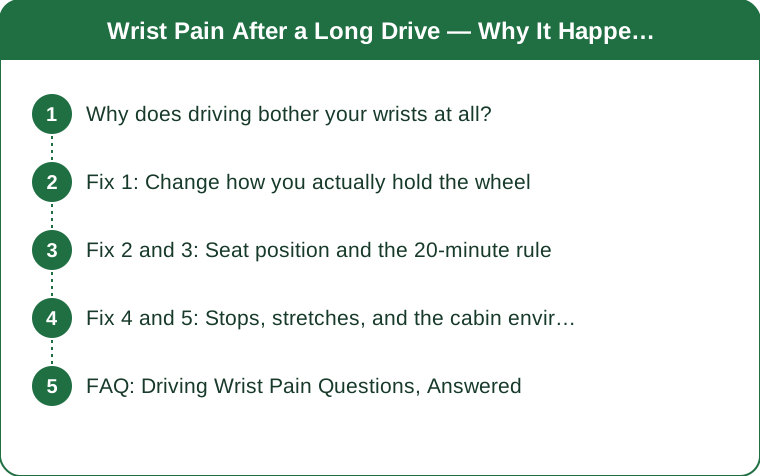
Why does driving bother your wrists at all?
Three things stack up, and none of them feel like effort at the time.
Sustained static grip. Your forearm flexors hold a low-level contraction continuously for the entire drive. Muscles tolerate high force briefly and low force briefly, but continuous low force with no relaxation phase is the pattern that produces aching, because blood flow through a continuously contracted muscle is reduced and metabolic byproducts accumulate.
Wrist extension. Most people grip the wheel with the wrist bent back slightly. Even 15 to 20 degrees of extension narrows the carpal tunnel measurably and increases pressure on the median nerve. Hold that for three hours and you get the tingling and ache that often gets blamed on the seat.
Vibration. Steering wheels transmit constant low-amplitude vibration from the road. Sustained hand-arm vibration is a well-documented contributor to hand and wrist symptoms in occupational settings, and while a passenger car is far milder than a power tool, three hours is a long exposure.
Add cool air conditioning blowing across your hands and you have the same peripheral cooling problem that makes desk work uncomfortable, layered on top.
Fix 1: Change how you actually hold the wheel
The single most useful change is where the pressure sits.
Most people grip with their fingers, curling them around the rim and squeezing. This puts the work entirely on the flexors and holds the wrist in extension.
Instead, let the base of your palm rest on the rim with fingers draped rather than clamped. Your hands should be doing much less than they are. On a straight highway, steering requires almost no force — the grip strength most people use is a habit, not a requirement.
Position at 9 and 3, which is both the modern safety recommendation and the position that keeps the wrist most neutral. The old 10-and-2 position rotates the forearms and adds extension.
Check your wrist angle directly: with your hands on the wheel, the back of your hand should be roughly in line with your forearm, not bent back. If it is bent, the wheel is likely too high or too far away.
And unclench. Most drivers grip hardest during exactly the situations where it helps least — heavy traffic, rain, unfamiliar roads. Noticing the clench is most of the fix.

Fix 2 and 3: Seat position and the 20-minute rule
Seat position determines wrist angle, so fix it before you fix anything else.
Set the seat so your elbows are bent to roughly 100 to 120 degrees with hands at 9 and 3. Arms fully extended forces the shoulders up and the wrists back. Arms too bent puts your hands high on the wheel and creates the same extension from the other direction.
Most cars let you adjust the wheel for both height and reach. Lower the wheel until your forearms are roughly parallel to the floor. A high wheel is the most common cause of driving wrist ache and almost nobody adjusts it after buying the car.
Then change your grip every 20 minutes. Not your position on the road — just where and how your hands sit. Move one hand to the lower rim for a minute. Rest a forearm on the door sill if the road is straight and empty. Open and close each hand a few times while the other steers.
The point is to give the muscle a relaxation phase. Continuous low-level contraction is the whole problem, and interrupting it every twenty minutes prevents almost all of it.
Set a repeating reminder for the first few long drives until it becomes automatic.
Fix 4 and 5: Stops, stretches, and the cabin environment
Stop every 90 minutes to two hours and give it two minutes. Not a full stretching routine — two minutes.
Wrist extensor stretch: arm straight out, palm down, gently pull the fingers down and toward you. 30 seconds each side. This is the one that addresses the muscle actually complaining.
Wrist flexor stretch: arm straight out, palm up, gently pull the fingers back. 30 seconds each side.
Fist to open, 10 times each hand. Restores circulation immediately and takes fifteen seconds.
Then address the cabin. Redirect any vent blowing across your hands — cool hands stiffen, and stiff hands grip harder. Cabin temperature that is comfortable for your torso is often too cold for your hands, especially on a long drive with the AC running.
Hydration matters more than people expect on road trips, because everyone deliberately drinks less to avoid stopping. Lower blood volume means worse peripheral circulation, which is the exact mechanism already under strain.
If you drive long distances regularly, padded driving gloves are not just a vintage affectation — they damp vibration meaningfully. This is general information, not medical advice; numbness or tingling that persists after the drive deserves a professional look.
FAQ: Driving Wrist Pain Questions, Answered
Is tingling in my fingers while driving serious?
Temporary tingling that resolves within minutes of changing grip is usually positional compression and not alarming. Tingling that persists after you stop, wakes you at night, or affects a specific pattern of fingers is worth having assessed — those are the patterns associated with nerve compression that benefits from earlier treatment.
Does a thicker steering wheel cover help?
Often, yes. A larger grip diameter reduces the amount of finger flexion required and distributes pressure across more of the palm. Cheap and worth trying if you drive a lot.
Should I wear a wrist brace while driving?
Generally no. A brace immobilizes the wrist, which conflicts with safe steering, and it does not address the grip and posture causes. Braces have a place for specific diagnosed conditions under guidance, not as a driving accessory.
Why is it worse on the return trip?
Cumulative fatigue plus, usually, less attention to position on the way home. It is also the drive where people push through without stopping to get home sooner, which removes the single most effective intervention.
Does cruise control help?
Indirectly. It frees your right leg and reduces overall tension, and it makes it easier to remember grip changes because you have less to manage. It does nothing for wrist position on its own.
TL;DR:
- Driving wrist pain comes from continuous low-level grip plus wrist extension plus vibration, not from effort.
- Grip at 9 and 3 with the base of the palm, fingers draped rather than clamped.
- Set elbows to 100 to 120 degrees and lower the wheel until forearms are roughly parallel to the floor.
- Change your grip every 20 minutes to give the muscle a relaxation phase.
- Stop every 90 minutes for a two-minute stretch, redirect vents off your hands, and keep drinking water.
Road trip wrist ache is almost entirely preventable, and none of the fixes cost anything or add time to the drive. Adjust the wheel before you pull out of the driveway and the whole problem usually disappears.
Keep Reading
This article is for general informational purposes only and is not medical advice. Always consult a qualified health professional for guidance specific to you.