Why Your Wrists Hurt in a Front Rack but Feel Fine in Push-Ups
Quick Answer: Push-ups load your wrist in extension with your forearm neutral, which most people tolerate well. A front rack demands extension plus full external rotation at the shoulder and forearm supination, and when shoulder or lat mobility is limited, the wrist absorbs the shortfall. The fix is almost always upstream — thoracic and shoulder mobility — not wrist stretching.
It is a confusing pattern. You can hold a plank for two minutes without complaint, then a light front squat lights your wrists up within three reps.

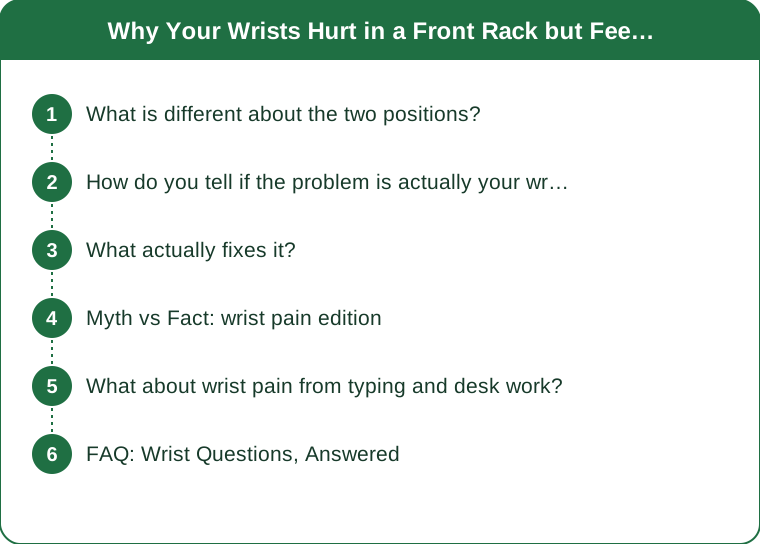
What is different about the two positions?
In a push-up, your wrist is extended to roughly 80 to 90 degrees, your forearm is in a neutral-to-pronated position, and the load runs straight down through the heel of your hand. It is a lot of extension, but it is a clean, aligned load.
In a front rack, the bar sits on your shoulders and your hands are there to keep it in place, not to hold it up. Getting your hands into that position requires substantial shoulder external rotation, thoracic extension, lat length, and triceps length.
When any of those are limited, your elbows drop, and a dropped elbow transfers bar weight from your shoulders onto your hands. Now your wrist is in extension under real load and at an angle it was not designed to bear. That is the pain, and it originates nowhere near your wrist.
How do you tell if the problem is actually your wrist?
A simple test. Sit at a table, place your forearm flat, and extend your wrist back as far as it goes with your other hand assisting gently. Most people reach 70 to 90 degrees comfortably.
If you have that range and the front rack still hurts, your wrist is fine and the problem is upstream.
The second test is the front rack itself without a bar. Get into position empty-handed and see whether you can point your elbows forward and up with your fingers on your shoulders. If your elbows sag and you cannot keep them high without effort, that is a shoulder and thoracic issue announcing itself.
Third, try the position with a two-finger grip rather than a full grip. If it feels dramatically better, that confirms your hands were carrying load they should not have been.
What actually fixes it?
Work the upstream restrictions, in this order.
Thoracic extension first. A foam roller placed across your mid-back with 10 slow extensions over it, done before every session, changes front rack position more than any wrist work will.
Lat length second. Lats limit overhead and front rack positions more than almost anything else. A kneeling lat stretch on a bench, holding 30 seconds per side, directly improves elbow height.
Shoulder external rotation third. A sleeper stretch or a doorway stretch at 90 degrees of abduction.
Then, and only then, work the wrist itself — controlled extension holds, gentle loaded rotations, and a proper warm-up of the joint before pressing.
In the meantime, use straps for front squats. Looping straps over the bar and holding those instead of gripping the bar removes the wrist from the equation entirely and lets you keep training while the mobility work catches up.

Myth vs Fact: wrist pain edition
Myth: Wrist pain means weak wrists. Fact: Weakness is rarely the cause of positional wrist pain in lifting. Position and load transfer are.
Myth: Wrist wraps fix wrist pain. Fact: Wraps stabilize and limit extension range, which helps with pressing. They do nothing for a front rack problem caused by shoulder mobility, and using them to push through positional pain delays the real fix.
Myth: You should stretch a painful wrist aggressively. Fact: Aggressive stretching of an irritated joint typically makes it worse. Gentle, frequent, pain-free range work does more.
Myth: If it only hurts in one exercise, you should just avoid that exercise. Fact: Sometimes reasonable, but a front rack limitation usually reflects a mobility restriction that shows up in overhead work and cleans too. It is worth addressing rather than routing around.
What about wrist pain from typing and desk work?
Different problem, and it interacts with training more than people realize.
Desk work holds your wrist in slight extension with the forearm pronated for hours. That sustained position shortens the forearm flexors and can irritate the tissue that passes through the carpal tunnel.
Someone arriving at the gym after eight hours of that has a wrist that is already at the edge of its comfortable range before the first rep.
A two-minute forearm mobility routine before training — flexor stretch, extensor stretch, and slow controlled rotations — makes a substantial difference for desk workers specifically, and it addresses the accumulated position rather than the training itself.
Persistent numbness, tingling, or night pain in the hand is a different category and worth professional attention rather than a mobility routine. This is general information, not medical advice.
FAQ: Wrist Questions, Answered
Should I train through wrist pain?
Not through pain that is sharp, that persists after the session, or that produces numbness. Discomfort at end range that resolves immediately is usually a position issue you can work around with straps or a modified grip.
Do wrist wraps weaken your wrists over time?
No good evidence for that, but they can mask a position problem you should be fixing. Use them for heavy pressing, not as a permanent solution to a mobility restriction.
How long does front rack mobility take to improve?
With daily thoracic and lat work, most people see meaningful change in three to six weeks. It is one of the more responsive mobility restrictions if you actually do the work consistently.
TL;DR:
- Push-ups load an aligned wrist; a front rack loads a misaligned one when shoulders and thoracic spine are tight.
- Test your wrist extension range — if it is normal, the problem is upstream.
- Fix thoracic extension, lat length, and shoulder external rotation in that order.
- Use straps for front squats in the meantime so you can keep training.
Wrists are usually the messenger rather than the problem. Spend six weeks on the shoulders and mid-back and most people find the wrist complaint disappears without ever having been addressed directly.
Keep Reading
This article is for general informational purposes only and is not medical advice. Always consult a qualified health professional for guidance specific to you.